
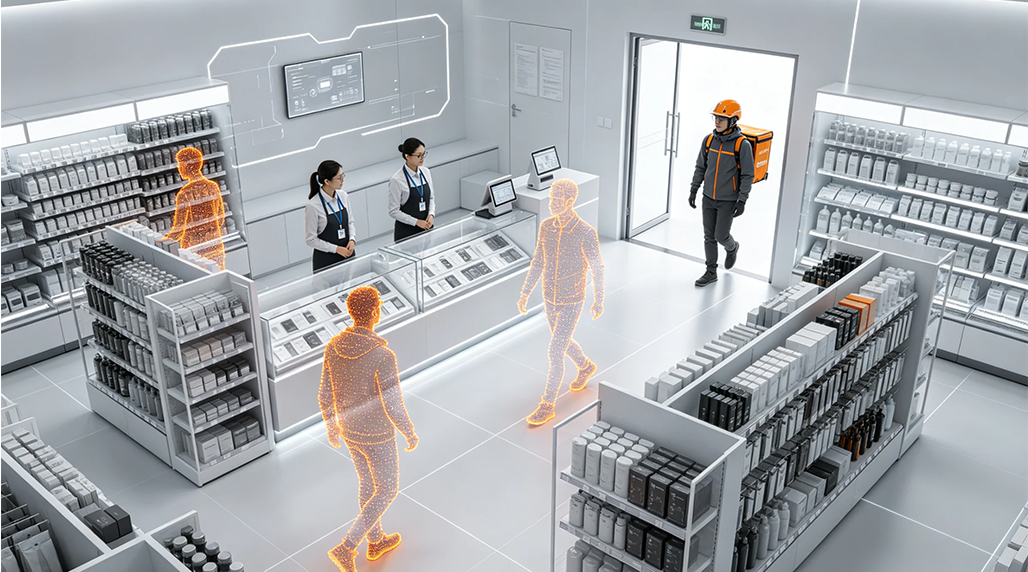
For decades, retailers have relied on Footfall Counting to understand how many people enter their stores. A simple visitor number seemed enough: more visitors should mean better performance, while fewer visitors indicated problems.
However, modern retail competition has changed this assumption.
Today, store managers are discovering that counting every person who walks through the door does not necessarily reveal business value. Employees entering and leaving, delivery workers, repeated visitors, and people who only pass through the store can significantly affect traditional traffic statistics.
This has created a new demand: moving from basic Footfall Counting to intelligent traffic analysis that identifies meaningful customer behavior.
The future of retail is not about knowing only “how many people came.” It is about understanding “how many real customers arrived, what they did, and how their behavior influenced sales.”
Why Traditional Footfall Counting Is No Longer Enough?
One of the most common questions retailers ask is:
“Why does my store receive high traffic but generate limited sales?”
The answer often lies in the difference between visitor numbers and customer value.
Traditional Footfall Counting systems mainly focus on entrance and exit numbers. They can tell retailers how many people entered a location, but they usually cannot determine:
- Whether visitors are actual shoppers
- Whether employees are included in the data
- Whether the same person enters multiple times
- How long customers stay inside
- Which areas attract attention
For example, a shopping store may record 1,000 daily visitors. But after removing employees, repeated visitors, and non-shopping traffic, the actual number of potential customers may be only 500.
This difference directly affects important business decisions, including conversion rate measurement, staffing plans, marketing evaluation, and store expansion strategies.
That is why retailers are moving toward Retail Traffic Analytics, where traffic data becomes a business intelligence resource instead of a simple counting number.
The Evolution From Counting People to Understanding Customers
The first generation of Footfall Counting technology was designed mainly for basic traffic measurement.
Early infrared counters could detect when someone crossed a doorway. These solutions were useful for simple visitor statistics but had limitations in complex retail environments.
Modern stores require deeper insights.
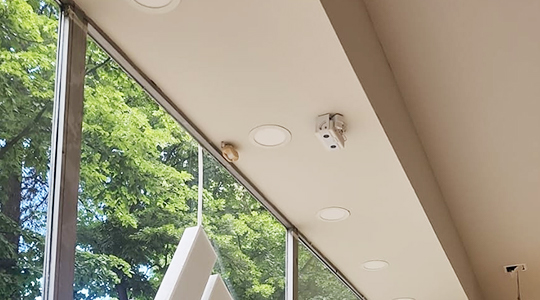
With AI vision technology, 3D sensing, and advanced algorithms, a new generation of People Counting System solutions can analyze customer movement more accurately.
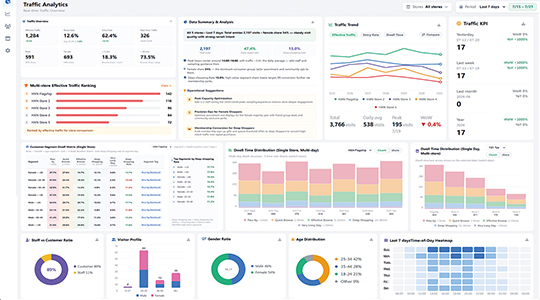
Modern intelligent systems can provide:
- Bidirectional visitor counting
- Customer dwell time analysis
- Employee exclusion
- Repeat visitor identification
- Customer flow visualization
- Age and gender estimation
- Area heatmap analysis
These capabilities allow retailers to move from “traffic measurement” to “customer behavior understanding.”
The purpose of Footfall Counting is no longer only to count visitors but to create accurate Customer Footfall Data that supports better decisions.
How Intelligent Traffic Analysis Improves Retail Decisions?
Another frequently asked question is:
“What can intelligent traffic analysis actually improve in a retail store?”
The answer includes several important areas.
1. More Accurate Conversion Rate Analysis
Conversion rate is one of the most important retail performance indicators.
The traditional formula is:
Sales ÷ Total Visitors = Conversion Rate
However, if visitor data contains employees or repeated entries, the calculation becomes inaccurate.
By using Effective Foot Traffic, retailers can understand the number of real purchasing opportunities instead of relying on inflated traffic numbers.
This provides a more realistic view of store performance.
A store with fewer but higher-quality customers may actually perform better than a store with large amounts of ineffective traffic.
2. Smarter Staff Scheduling
Many retailers struggle with one question:
“How many employees do we need at different times?”
Without accurate traffic insights, stores often schedule employees based on experience rather than data.
Through Store Traffic Analysis, managers can identify:
- Peak customer periods
- Low-traffic hours
- Customer waiting patterns
- Service demand changes
This helps stores improve customer experience while reducing unnecessary labor costs.
3. Better Marketing ROI Evaluation
Marketing campaigns often increase store visits, but increased visitors do not always mean increased revenue.
A promotion may attract many visitors, but if most visitors have low purchase intent, the campaign value may be limited.
Intelligent Retail Traffic Analytics helps businesses compare:
- Campaign exposure
- Customer visits
- Store engagement
- Purchase conversion
This creates a clearer understanding of whether marketing activities generate real business value.
What Technologies Make Intelligent Footfall Analysis Possible?
The transformation from traditional counting to intelligent analysis depends on several technologies.
AI Computer Vision
AI-based cameras can recognize human movement patterns while protecting privacy. Unlike traditional surveillance systems, modern retail analytics solutions focus on anonymous data processing rather than personal identification.
3D Vision Technology
3D sensors improve accuracy in crowded environments by analyzing depth information. They reduce errors caused by overlapping people, shopping carts, or changing lighting conditions.
Re-identification Algorithms
Advanced algorithms can identify repeated visits within the same environment, helping retailers remove duplicate traffic from statistics.
Edge Computing
Processing data locally through edge devices improves response speed and reduces dependence on cloud transmission.
Together, these technologies transform Footfall Counting into a complete customer intelligence solution.
Frequently Asked Questions About Intelligent Footfall Analysis
Q1: Is Footfall Counting only about counting visitors?
No.
Modern Footfall Counting has evolved into intelligent traffic measurement. The goal is not simply counting people but understanding customer quality, behavior patterns, and business impact.
Q2: How accurate are modern retail people counting systems?
Accuracy depends on technology, installation environment, and algorithms. Advanced AI and 3D vision systems can achieve very high accuracy in controlled retail environments, especially when compared with traditional infrared counting solutions.
Q3: Can intelligent traffic analysis protect customer privacy?
Yes.
Many modern solutions use anonymous AI processing. They analyze movement patterns, customer flow, and statistical information without collecting personally identifiable information.
This makes intelligent traffic analytics suitable for privacy-sensitive markets.
The Future of Retail Traffic Measurement
Retail is entering a data-driven era.
The question for businesses is no longer:
“How many people entered my store?”
The more important question is:
“How many valuable customers visited, what did they do, and how can we improve their experience?”
The transition from Footfall Counting to intelligent traffic analysis represents a major change in retail management.
Traditional counting provides numbers.
Intelligent analysis provides decisions.
With accurate Customer Footfall Data, advanced Retail Traffic Analytics, and deeper Store Traffic Analysis, retailers can improve conversion rates, optimize operations, and understand customer behavior with greater confidence.
The future of retail success will belong to businesses that can transform traffic data into actionable intelligence.