
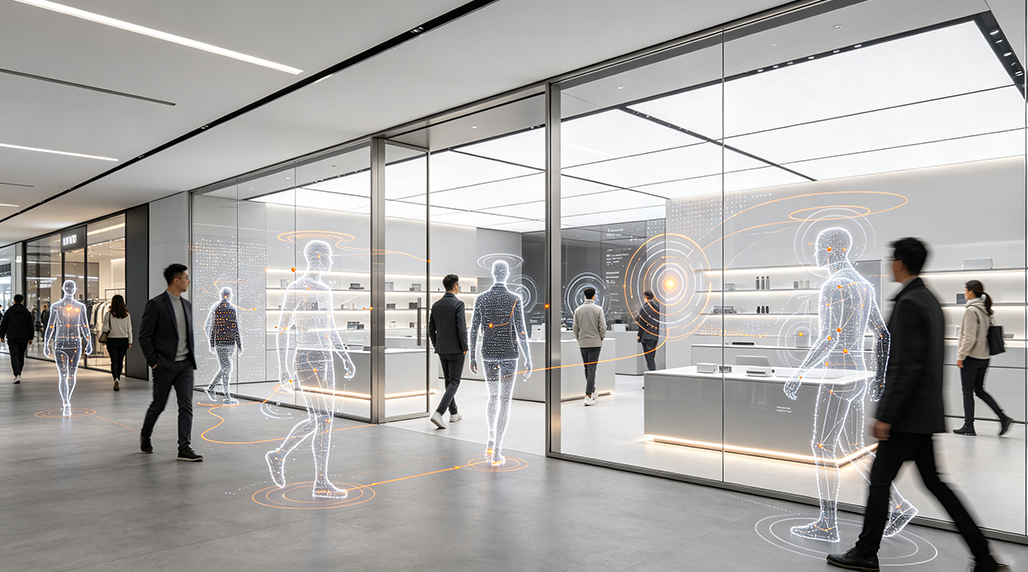
For many retailers, understanding store performance starts with one simple question: “How many people entered the store today?”
However, in modern retail management, visitor numbers alone are no longer enough.
A store may have high traffic but poor sales conversion. Another store may receive fewer visitors but generate higher revenue because the visitors have stronger purchase intent.
This is why more retailers are adopting AI-Powered People Counting technology. Instead of only recording entry and exit numbers, AI-based solutions combine computer vision, machine learning, and real-time data analysis to help retailers understand customer flow, behavior patterns, and operational efficiency.
Modern retail success depends not only on attracting visitors but also on identifying valuable traffic and converting that traffic into business growth.
What Is AI-Powered People Counting and Why Does Retail Need It?
Traditional people counters mainly answer “how many people passed through an entrance.”
While this information is useful, it lacks business context.
A simple counting device cannot easily distinguish:
- Employees walking through the entrance repeatedly
- Delivery personnel entering the store
- The same customer entering multiple times
- Groups moving together
- Visitors who only browse without purchase intention
As a result, traditional traffic measurement may create misleading conclusions.
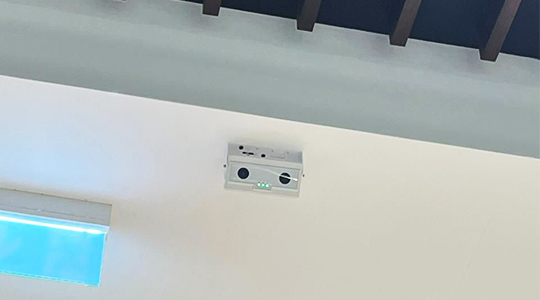
AI-Powered People Counting improves this process by using AI recognition algorithms to analyze human movement patterns. It can identify individuals based on anonymous features, track movement direction, and remove unnecessary noise from traffic data.
The goal is not simply counting more people. The goal is generating more meaningful data.
This shift changes retail measurement from “visitor quantity” to “traffic quality.”
For example, a fashion retailer comparing two stores may discover that Store A receives 3,000 visitors weekly, while Store B receives only 2,200 visitors. However, after excluding employees and repeated visits, Store B may have a higher percentage of real shoppers and better conversion performance.
This is where Foot Traffic Analysis becomes valuable.
How Does AI-Powered People Counting Improve Store Performance Analysis?
1. Provides More Accurate Customer Traffic Data
One of the biggest advantages of AI-Powered People Counting is improving data accuracy.
Retail decisions depend heavily on traffic data:
- Store location evaluation
- Employee scheduling
- Marketing campaign measurement
- Store layout optimization
- Conversion rate analysis
If the original traffic data is inaccurate, every following decision may also be incorrect.
AI-powered systems use technologies such as computer vision, deep learning models, and edge processing to recognize human movement more effectively.
Compared with traditional infrared or manual counting methods, AI systems can better handle complex environments, including crowded entrances, changing lighting conditions, and multiple people walking together.
For chain retailers, accurate data consistency across hundreds of stores is especially important. A unified People Counting System allows companies to compare store performance based on the same measurement standards.
Frequently Asked Question 1:
Is AI people counting more accurate than traditional counting methods?
Yes, in most retail environments, AI-based solutions provide more detailed and reliable analysis.
Traditional counters usually measure only movement events. AI systems analyze human patterns and can filter unnecessary traffic sources.
However, accuracy depends on installation quality, environment conditions, camera position, and algorithm performance.
The most valuable improvement is not only higher counting accuracy but better understanding of what the traffic represents.
2. Helps Retailers Understand Customer Behavior
Counting visitors is only the first step.
Retailers also need to know:
- Where customers spend time
- Which areas attract attention
- How customers move inside the store
- Which sections have low engagement
This is where Customer Behavior Analysis becomes important.
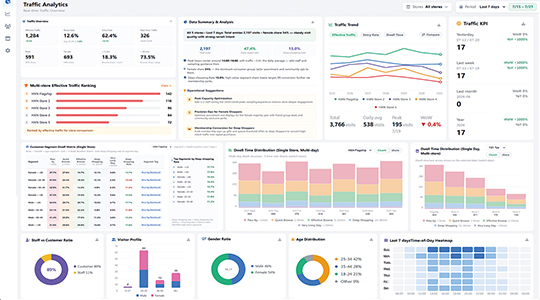
AI-powered retail analytics can transform traffic information into behavioral insights through heatmaps, dwell-time measurement, and movement analysis.
For example:
A supermarket may find that customers spend very little time near a high-margin product area. The problem may not be product quality but poor placement.
A clothing store may discover that customers frequently enter but leave within two minutes. This could indicate issues with store atmosphere, product display, or customer service response.
Instead of relying only on sales results, retailers can analyze the reasons behind those results.
Frequently Asked Question 2:
Can AI people counting improve retail sales?
AI does not directly create sales, but it helps retailers make better decisions.
By understanding traffic patterns, retailers can:
- Adjust employee schedules according to customer demand
- Improve store layouts
- Evaluate marketing effectiveness
- Increase conversion opportunities
For example, if a promotion attracts many visitors but does not improve purchase conversion, retailers can analyze whether the problem comes from customer quality, product placement, or sales support.
Better decisions create better business outcomes.
3. Converts Traffic Data Into Store Optimization Strategies
Many retailers still measure stores mainly through revenue.
Revenue is important, but it is a result.
Traffic data provides earlier signals.
A decline in sales may happen because:
- Fewer customers visit the store
- Customer quality decreases
- Staff response is insufficient
- Store layout affects shopping experience
With Store Performance Optimization, retailers can combine traffic data with sales information to understand the complete business picture.
For example:
A store manager notices weekday traffic is stable but sales are decreasing.
Traditional analysis may suggest increasing promotions.
However, AI traffic analysis may reveal that customers enter normally but spend less time inside specific product zones.
The solution may not be more advertising. It may be improving product presentation or staff engagement.
This demonstrates why modern retailers are moving from simple counting toward intelligent analysis.
Frequently Asked Question 3:
Can AI people counting remove employees and repeated visitors?
Advanced systems can reduce these problems through AI recognition technologies.
Many solutions include features such as:
- Employee filtering
- Anonymous re-identification
- Duplicate visitor reduction
- Direction detection
These functions help retailers measure more realistic customer traffic.
The concept of effective foot traffic has become increasingly important because raw visitor numbers often include non-business-related movements.
By focusing on real potential customers instead of total movement volume, retailers can calculate more meaningful conversion rates.
The Future of Retail Analytics: From Counting Visitors to Understanding Customers
The future of retail is not about collecting more data. It is about collecting better data.
AI-powered solutions are helping physical stores achieve the same level of analytical capability that online businesses already have.
E-commerce platforms can track:
- Visitor sources
- Browsing behavior
- Conversion paths
- Customer preferences
Physical stores traditionally lacked this visibility.
Now, AI-Powered People Counting is helping bridge this gap by providing real-world customer insights while maintaining privacy-friendly data processing.
Edge AI technology is also becoming increasingly important because it allows data analysis to happen closer to the device, reducing latency and improving privacy protection.
Conclusion: AI-Powered People Counting Is Becoming the Foundation of Smart Retail Decisions
Retail competition is no longer determined only by how many people enter a store.
The key question is:
“Are these visitors creating real business value?”
AI-Powered People Counting enables retailers to move beyond basic visitor measurement and enter a new stage of data-driven management.
Through accurate traffic measurement, Retail Analytics, Foot Traffic Analysis, and Customer Behavior Analysis, retailers can better understand customers, improve operations, and optimize store performance.
The future retail leader will not simply count more visitors.
They will understand every valuable customer interaction behind the numbers.