
Understanding the Difference Between Footfall Counters and People Counters in Retail Analytics
Retailers increasingly rely on customer traffic data to optimize store operations, improve customer experience, and measure marketing performance. However, when choosing a tracking solution, many businesses face a common question: Should I use a footfall counter or a people counter for store analytics?
Although these two terms are often used interchangeably, they focus on slightly different aspects of visitor measurement. A footfall counter mainly measures the volume of traffic passing through a location, while a people counter provides more detailed information about individuals entering, exiting, and interacting with a retail environment.
Choosing the right technology depends on what type of store analytics insights a business needs.
What Is a Footfall Counter?
A footfall counter is a system designed to measure the number of people passing through a specific area, usually a store entrance, shopping mall corridor, or public space.
Traditional footfall counting systems focus on basic traffic measurement, such as:
- Number of entries
- Number of exits
- Visitor volume by time period
- Peak traffic hours
- Daily or weekly traffic trends
For retailers, footfall data helps answer basic operational questions:
- How many people visited the store today?
- Which hours receive the highest traffic?
- Did a promotion increase store visits?
- How does traffic change between weekdays and weekends?
Footfall counters are commonly used in retail stores, shopping centers, transportation hubs, and event venues where measuring overall movement volume is the primary goal.
However, traditional footfall counting has limitations. A simple traffic count does not always represent real customers. For example, the data may include:
- Employees entering the store
- Delivery personnel
- Service workers
- Customers passing through repeatedly
As a result, raw footfall data may not always reflect actual customer opportunities.
What Is a People Counter?
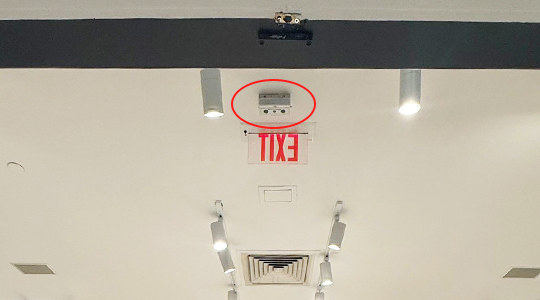
A people counter is a more advanced customer traffic measurement system that identifies and analyzes human movement using technologies such as AI algorithms, 3D vision, stereo cameras, infrared sensors, or time-of-flight technology.
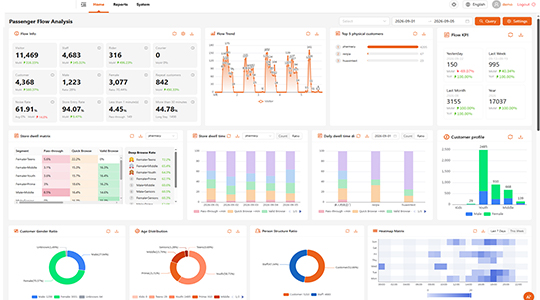
Unlike basic footfall counters, modern people counters can provide deeper store analytics, including:
- Accurate visitor counting
- Entry and exit direction detection
- Occupancy monitoring
- Dwell time analysis
- Customer flow analysis
- Visitor behavior insights
Advanced AI people counting systems can also improve data quality through intelligent filtering capabilities, such as:
- Staff exclusion
- Repeat visitor filtering
- Adult and child classification
- Gender and age analysis
This allows retailers to move from simple traffic measurement toward effective customer traffic analytics.
Instead of only knowing how many people entered a store, businesses can better understand how many potential customers actually interacted with the retail environment.
Footfall Counter vs People Counter: Key Differences
| Feature | Footfall Counter | People Counter |
|---|---|---|
| Main purpose | Measure traffic volume | Analyze visitor behavior |
| Basic counting | Yes | Yes |
| Entry/exit detection | Yes | Yes |
| Customer identification | Limited | Advanced |
| Staff filtering | Usually unavailable | Available in advanced systems |
| Repeat visitor filtering | Limited | Available with AI Re-ID technology |
| Dwell time analysis | Rare | Available |
| Demographic insights | No | Possible |
| Store conversion analysis | Limited | Stronger |
The biggest difference is that a footfall counter answers “How much traffic did we receive?”
A people counter helps answer “Who are these visitors and what value do they represent?”
Which One Is Better for Store Analytics?
The right choice depends on the retailer’s business goals.
Choose a Footfall Counter If You Need Basic Traffic Measurement
A footfall counter may be enough when the goal is simply to monitor visitor volume.
Typical use cases include:
- Small retail stores
- Public entrances
- Shopping center traffic monitoring
- Basic occupancy management
- Event attendance counting
For example, a store manager may only need to know whether weekend traffic is higher than weekday traffic.
In this situation, basic footfall measurement can provide useful operational information at a lower cost.
Choose a People Counter If You Need Customer Behavior Insights
A people counter is usually the better choice for retailers that want to optimize performance using data.
Retail businesses often need answers beyond visitor numbers:
- Why does one store generate more sales than another?
- Are marketing campaigns bringing real customers?
- Are employees affecting traffic reports?
- How long do customers stay inside?
- Which locations attract more valuable visitors?
AI-based people counting systems provide more detailed customer traffic analytics by converting raw movement data into actionable insights.
For multi-store retailers, this information can support:
- Store performance comparison
- Staffing optimization
- Layout improvement
- Marketing evaluation
- Customer experience improvement
How AI Technology Improves People Counting Accuracy
Modern retail analytics increasingly uses AI-powered 3D people counting technology instead of traditional counting methods.
Advanced systems combine:
- Stereo vision technology
- AI detection algorithms
- Depth information analysis
- Edge computing
- Re-identification algorithms
These technologies improve accuracy in complex environments, including:
- Crowded store entrances
- Multiple people walking together
- Different lighting conditions
- High-traffic retail locations
For example, AI Re-ID technology can recognize whether the same visitor appears multiple times in different counting areas, reducing duplicate traffic data.
This helps retailers calculate more meaningful metrics such as effective customer traffic, which focuses on actual customer opportunities rather than total movement.
Frequently Asked Questions About Footfall Counters and People Counters
1. Is a people counter more accurate than a footfall counter?
In many retail environments, advanced people counters can provide higher accuracy because they use AI algorithms and 3D sensing technologies to distinguish human movement patterns.
Traditional footfall counters usually focus on counting passing traffic, while modern people counters can filter complex situations such as repeated visits or non-customer movement.
2. Can a people counter help increase retail sales?
A people counter does not directly increase sales, but it provides data that helps retailers make better decisions.
By analyzing customer traffic, dwell time, and visitor patterns, businesses can optimize:
- Store layouts
- Staff scheduling
- Promotional campaigns
- Customer engagement strategies
Better traffic insights can improve conversion opportunities.
3. Do retailers still need footfall counters?
Yes. Footfall counters remain useful for businesses that only require basic traffic measurement.
However, retailers that depend on customer analytics, multi-store management, and performance optimization often benefit more from advanced people counting solutions.
Conclusion: Footfall Counter or People Counter?
The choice between a footfall counter and a people counter depends on the depth of analytics a retailer requires.
A footfall counter is suitable for measuring basic visitor volume and traffic trends.
A people counter is better for businesses that want deeper customer insights, including visitor behavior analysis, staff filtering, repeat visitor reduction, and effective customer traffic measurement.
For modern retail analytics, the trend is moving from simply counting people to understanding customer value. Businesses are increasingly adopting AI-powered people counting systems to transform raw traffic data into meaningful insights that support smarter retail decisions.