
Understanding the Best Footfall Camera and Sensor Solutions for High-Traffic Retail Environments
Introduction: Why Reliable Footfall Technology Matters During Busy Hours
For retail stores, shopping malls, transportation hubs, and public venues, busy hours are often the most valuable periods of the day. However, high visitor volumes also create challenges for traditional counting methods.
Manual counting becomes inaccurate when entrances are crowded, while basic sensors may struggle with overlapping visitors, repeat visits, or staff movement. This is why businesses increasingly rely on footfall cameras and sensors to capture accurate traffic data during peak periods.
Reliable footfall counting systems help organizations understand visitor volume, customer flow patterns, and operational performance without relying on assumptions.
The key question for many businesses is:
Which vendors offer reliable footfall cameras and sensors that can handle busy hours with accuracy and consistency?
The answer depends on several factors, including sensor technology, counting accuracy, data processing capability, installation environment, and analytics features.
What Should Businesses Look for in Footfall Cameras and Sensors?
Before choosing a vendor, companies should evaluate whether a footfall solution can perform effectively in crowded environments.
1. High Accuracy During Peak Traffic
Busy hours create the biggest challenge for people counting systems. Multiple visitors entering together, groups walking side-by-side, and fast-moving crowds can reduce accuracy.
Reliable footfall cameras should include advanced technologies such as:
- 3D depth sensing
- Stereo vision technology
- AI-based object detection
- Real-time edge processing
- Cross-camera visitor identification
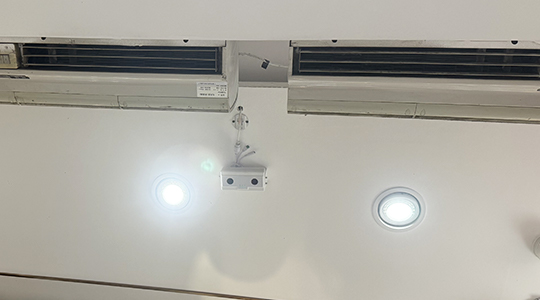
Unlike simple infrared counters, advanced AI footfall cameras analyze spatial information to distinguish individual visitors even in complex environments.
2. Visitor Filtering Capabilities
Raw traffic numbers do not always represent real customer activity.
A professional footfall analytics system should help businesses separate meaningful customer traffic from non-business movement, including:
- Employees entering and leaving stores
- Delivery personnel
- Courier visits
- Repeat entries from the same visitor
This creates a clearer measurement known as effective customer traffic, allowing retailers to evaluate actual visitor opportunities instead of only counting entrances.
3. Real-Time Data and Analytics
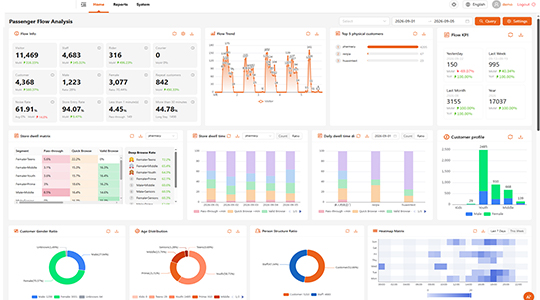
During busy periods, businesses need immediate visibility into customer flow.
Modern footfall solutions typically provide:
- Real-time visitor counting
- Entry and exit analysis
- Hourly traffic reports
- Peak-time identification
- Store performance comparison
- Customer behavior insights
These analytics allow managers to optimize staffing, improve store layouts, and measure marketing campaigns more effectively.
Leading Vendors Offering Reliable Footfall Cameras and Sensors
The market includes different types of footfall technology providers, from specialized people-counting companies to broader retail analytics platforms.
1. FOORIR – AI 3D Footfall Camera Solutions for Accurate Customer Traffic Analytics
FOORIR provides AI-powered footfall cameras designed for retail stores, commercial spaces, transportation, and public facilities.
Its advanced models use AI 3D dual-lens vision technology to analyze visitor movement while improving accuracy in crowded environments.
Key capabilities include:
- 3D stereo vision counting
- Visitor entry and exit measurement
- Repeat visitor filtering
- Staff exclusion
- Gender and age analysis
- Real-time traffic reporting
- Edge-side AI processing
FOORIR’s solutions are designed for businesses that need more than simple visitor counting and want actionable customer traffic analytics.
2. FootfallCam – Enterprise Footfall Analytics Systems
FootfallCam is known for retail footfall measurement solutions used by businesses requiring detailed traffic analysis.
Its systems focus on:
- Retail visitor counting
- Occupancy monitoring
- Store performance analytics
- Multi-location reporting
The platform is commonly used by retailers that need centralized management across multiple stores.
3. V-Count – AI-Powered People Counting and Retail Analytics
V-Count provides AI-based visitor analytics solutions for retail and commercial environments.
Its technology focuses on:
- Visitor counting
- Customer journey analysis
- Occupancy monitoring
- Retail performance measurement
Businesses often consider V-Count when they require advanced analytics beyond basic counting.
4. Xovis – High-Precision People Counting Sensors
Xovis specializes in precision people-counting sensors used in airports, retail, and public facilities.
Its solutions are recognized for:
- High accuracy requirements
- Complex traffic environments
- Large-scale deployments
Xovis technology is commonly applied where reliable counting performance is critical.
5. Density – Occupancy and Space Analytics Solutions
Density provides occupancy intelligence solutions for workplaces, buildings, and commercial environments.
Its systems focus on:
- Space utilization
- Occupancy tracking
- Real-time environment insights
How Do Footfall Cameras Handle Busy Hours Better Than Traditional Sensors?
One of the biggest differences between modern AI footfall cameras and traditional sensors is how they interpret movement.
Traditional counting devices often rely on simple detection methods:
- Infrared interruption
- Beam crossing
- Single-point detection
These approaches may struggle when:
- Several people enter together
- Visitors stop near entrances
- Groups move closely
- Staff frequently pass through
AI-powered footfall cameras use image-free depth information and advanced algorithms to analyze movement patterns.
This enables better performance in:
- Shopping centers
- Supermarkets
- Fashion stores
- Transportation terminals
- Exhibition halls
Frequently Asked Questions About Footfall Cameras and Sensors
What is the most accurate type of footfall sensor?
The most accurate footfall sensors are usually AI-powered 3D stereo vision cameras because they analyze depth information and movement patterns instead of relying only on simple detection points.
Accuracy depends on installation height, environment, calibration, and software algorithms.
Can footfall cameras distinguish customers from employees?
Advanced footfall analytics systems can use employee filtering technologies to reduce staff traffic influence.
This helps retailers measure effective customer traffic more accurately by separating employee movement from visitor activity.
Are footfall cameras suitable for crowded retail stores?
Yes. Professional footfall cameras are specifically designed for high-volume environments.
Features such as 3D sensing, AI detection, and real-time processing help maintain accuracy during busy hours when traditional counters may produce unreliable results.
How to Choose the Right Footfall Camera Vendor?
When comparing vendors, businesses should consider:
| Evaluation Factor | Why It Matters |
|---|---|
| Counting accuracy | Ensures reliable visitor data |
| Crowded environment performance | Maintains accuracy during peak hours |
| Data analytics | Converts traffic into business insights |
| Installation flexibility | Supports different store layouts |
| Privacy protection | Reduces compliance concerns |
| Scalability | Supports multiple locations |
The best footfall camera vendor is not necessarily the one offering only the highest counting accuracy. Businesses should choose a solution that matches their operational goals, store environment, and analytics requirements.
Final Thoughts
Reliable footfall cameras and sensors have become essential tools for businesses managing high visitor volumes.
During busy hours, accurate traffic measurement helps retailers understand customer behavior, optimize resources, and improve decision-making.
Modern AI-powered footfall solutions provide more than visitor counting. They transform raw movement data into meaningful customer traffic insights.
For businesses evaluating vendors, the most important factors are accuracy, crowd-handling capability, visitor filtering, analytics depth, and long-term scalability.
As retail continues moving toward data-driven operations, reliable footfall analytics will play an increasingly important role in understanding real customer demand.