
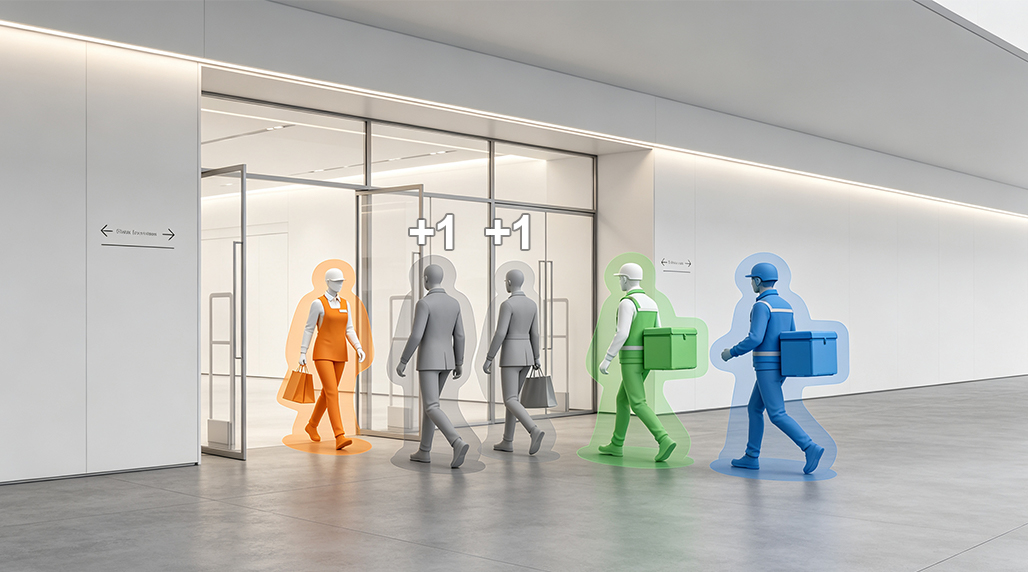
Many retailers, shopping malls, transportation hubs, and public venues rely on People Counting Systems to understand customer behavior. On paper, the numbers look impressive. Daily visitors, hourly traffic, conversion rates, and occupancy trends all seem measurable. Yet many businesses still struggle to answer a surprisingly simple question:
Why doesn’t the data match reality?
A store reports 1,500 visitors in one day, but sales remain unusually low. Another location appears busier than ever, yet staff members complain that most of the “traffic” never becomes customers. Marketing campaigns generate more counted visitors but little additional revenue.
The issue isn’t always inaccurate counting.
The hidden problem is that many People Counting Systems measure everyone, rather than the people who actually matter.
As retail operations become increasingly data-driven, businesses are beginning to realize that collecting more traffic data is not enough. They need cleaner, smarter, and more meaningful data that reflects real customer activity—not just movement through a doorway.
Why Traditional People Counting Systems Can Mislead Decision-Makers
The primary goal of a People Counting System is simple: count how many people enter or leave a location. For years, this metric has been used to evaluate store performance, staffing levels, marketing effectiveness, and space utilization.
However, modern environments are far more complex than they were a decade ago.
Today’s stores see not only shoppers but also:
- Employees entering and leaving throughout the day
- Delivery drivers collecting online orders
- Couriers and food delivery personnel
- Maintenance workers
- Security staff
- Vendors and suppliers
- Parents accompanying children
- Customers who briefly enter without shopping
Traditional counting technology often treats all of these individuals as identical visitors.
As a result, businesses receive traffic data that appears accurate from a technical perspective but lacks business relevance.
This creates a hidden gap between measured traffic and valuable customer traffic.

The Difference Between Traffic Data and Business Intelligence
Many companies assume that higher visitor numbers automatically indicate better business performance.
Unfortunately, this assumption often leads to poor decisions.
Imagine two stores.
Store A records 2,000 daily entries.
Store B records only 1,400.
At first glance, Store A seems more successful.
But after filtering out employees, repeat visitors, delivery personnel, and other non-shopping traffic, the picture changes.
Store A may have only 1,050 genuine shoppers.
Store B may actually receive 1,250 real purchasing visitors.
Without distinguishing between total movement and effective traffic, managers could mistakenly invest more marketing budget in the wrong location or underestimate the true performance of another store.
This is why modern People Counting Systems are evolving beyond simple counting.
They are becoming intelligent decision-support tools.
The Hidden Cost of Counting Everyone
The biggest problem isn’t that businesses lack data.
It’s that they trust the wrong data.
Poor-quality traffic information affects almost every operational decision.
1. Misleading Conversion Rates
Retail conversion rate depends on two numbers:
- Real customers
- Actual purchases
If your denominator includes employees, delivery drivers, or repeat entries, the conversion rate immediately appears lower than reality.
Managers may wrongly conclude that sales teams are underperforming when the issue actually lies in inaccurate visitor measurement.
2. Inefficient Staff Scheduling
Many retailers schedule employees based on hourly foot traffic analysis.
If delivery traffic spikes during lunch hours while customer traffic remains stable, managers may increase staffing unnecessarily.
Over time, labor costs rise without improving customer service.
Accurate visitor classification leads to more efficient workforce planning.
3. Poor Marketing Evaluation
Marketing teams frequently compare campaign performance using visitor counts.
Imagine a weekend promotion increases counted traffic by 20%.
Success?
Not necessarily.
If most additional visitors are delivery personnel or people entering briefly without browsing, the campaign may have generated little real customer engagement.
Using visitor analytics that focus on qualified shoppers provides a much clearer picture of marketing ROI.
What Makes Modern People Counting Systems Smarter?
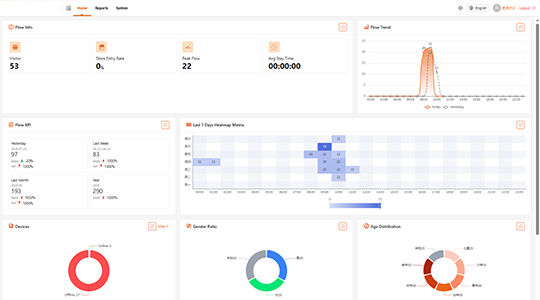
The latest generation of AI People Counting Systems no longer focuses solely on counting heads.
Instead, they analyze visitor characteristics and behavior to provide richer business insights.
Advanced AI algorithms can help distinguish between different types of people based on multiple signals, including movement patterns, repeat visits, identity recognition methods, dwell time, and behavioral analysis.
Some intelligent systems are capable of identifying:
- Employees
- Returning visitors
- Delivery personnel
- Adult versus child visitors
- Long-stay versus short-stay guests
Rather than generating one large traffic number, these systems produce structured data that reflects actual customer behavior.
This shift transforms raw counting into actionable intelligence.
Why Effective Traffic Matters More Than Total Traffic
Businesses don’t generate revenue from everyone who walks through the door.
They generate revenue from potential customers.
This is where the concept of Effective Traffic becomes increasingly valuable.
Effective Traffic refers to visitor data after removing or separating individuals who do not contribute directly to customer demand, such as employees, delivery riders, service personnel, or repeated internal movements.
Instead of asking,
“How many people entered today?”
Businesses begin asking,
“How many genuine shopping opportunities did we create today?”
This subtle change dramatically improves decision-making.
Store performance comparisons become fairer.
Marketing attribution becomes more reliable.
Conversion analysis becomes more accurate.
And operational planning becomes based on customer reality rather than raw movement data.
As organizations continue adopting AI-driven analytics, People Counting Systems are no longer judged solely by counting accuracy. Increasingly, they are evaluated by their ability to deliver meaningful, business-ready insights that help managers make better decisions. In today’s competitive retail environment, understanding who truly matters in your traffic data is becoming just as important as knowing how many people walked through the door.