
Introduction: Why “traffic numbers” are no longer enough
Retail used to rely on a simple belief: more visitors equals better performance. But in today’s data-driven environment, that idea is no longer reliable. A store may record 10,000 entries per week, yet only a fraction of those people are real shoppers. Some are staff moving in and out, some are delivery riders, and others are repeat pass-bys that never engage.
This is where real customer traffic measurement in retail stores accurately becomes essential. It is not just about counting people—it is about identifying meaningful visitors who have purchase intent and actual engagement inside the store.
Modern retail decisions depend on this accuracy. From staffing to layout design, from marketing ROI to conversion tracking, everything starts with one question: who actually counts as a customer?
To answer this, we need to break down both the concept and the measurement systems behind it.
1. What “real customer traffic” actually means
The first challenge in real customer traffic measurement in retail stores accurately is definition. Many systems still focus on raw footfall, but raw numbers often mislead decision-making.
True retail traffic should exclude:
- Employees entering and leaving multiple times
- Delivery and logistics personnel
- Non-shopping pass-through movement
- Repeated detection of the same person within short intervals
Instead, it should focus on visitors who enter, stay, and potentially engage with products.
This is where retail foot traffic analytics becomes important. It shifts the focus from counting bodies to understanding behavior patterns. For example, dwell time, movement paths, and revisit frequency provide far more meaningful insight than simple entry counts.
In practical terms, a store with 500 “real visitors” can outperform one with 1,500 raw entries if engagement quality is higher.
That is why modern systems prioritize filtering logic over simple counting.
2. Core technologies used in modern traffic measurement
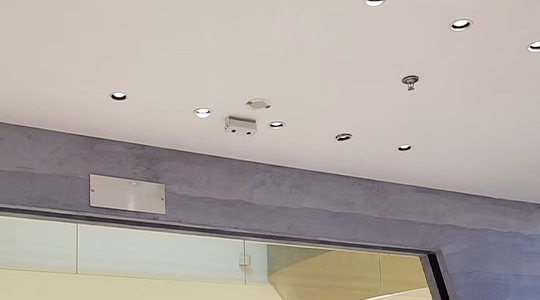
To achieve real customer traffic measurement in retail stores accurately, retailers rely on multiple sensing technologies instead of a single method.
The most common systems include:
- AI-based stereo vision cameras
- Infrared beam counters
- 3D depth sensors (ToF technology)
- Edge computing analytics devices
- Cloud-based visitor tracking platforms
Each technology has strengths and weaknesses. For example, infrared sensors are cost-effective but struggle with dense crowds. AI cameras provide better accuracy but require proper installation height and calibration.
A major improvement in recent years is the integration of people counting systems with AI filtering models. These models can distinguish between humans and non-customer objects, reduce duplication, and track directionality.
Another key factor is cross-system calibration. A single sensor at the entrance is no longer enough. Multi-point detection (entrance + zone tracking) gives a clearer picture of in-store movement.
At this stage, accuracy is no longer just hardware-based. It depends heavily on algorithm quality and data interpretation.
3. The hidden problem: “fake traffic” inside retail stores
One of the biggest challenges in real customer traffic measurement in retail stores accurately is the presence of “non-revenue traffic.”
These include:
- Staff movement during shifts
- Delivery drop-offs
- Cleaning and maintenance activity
- People entering but not engaging with products
This creates a distortion in performance metrics. A store may appear busy, but conversion remains low.
To solve this, modern systems introduce behavior filtering layers similar to conversion rate optimization retail logic. Instead of only counting entries, systems analyze:
- Time spent inside store zones
- Movement depth (entrance-only vs full-store visits)
- Repeat entry frequency within short periods
- Activity clustering near product areas
This leads to a more realistic metric sometimes called “effective traffic.”
In many cases, effective traffic is 20–40% lower than raw footfall—but far more valuable for decision-making.
Without this adjustment, retailers often overestimate marketing success or misjudge store performance.
4. How AI improves measurement accuracy
The evolution of real customer traffic measurement in retail stores accurately is closely tied to AI development.
Modern systems use machine learning models that continuously improve detection accuracy. These systems can:
- Differentiate adults, children, and staff uniforms
- Reduce duplicate counting using trajectory tracking
- Identify direction (entering vs exiting)
- Detect group behavior patterns
This is where in-store visitor tracking becomes powerful. Instead of static counting, retailers can understand movement flows across time.
For example, AI can show that:
- 60% of visitors only reach the entrance zone
- 25% move to product shelves
- 15% interact with high-value zones
This insight changes store layout strategy completely.
Additionally, AI helps reduce environmental noise—such as lighting changes, reflections, or crowd congestion—that traditionally affected accuracy.
The result is not just better counting, but better interpretation.
5. Common mistakes retailers make when measuring traffic
Even with advanced tools, many retailers still misinterpret data from real customer traffic measurement in retail stores accurately systems.
Here are the most common mistakes:
1. Confusing footfall with performance
High traffic does not always mean high sales.
2. Ignoring staff filtering
Without separating employees, data becomes inflated.
3. Relying on single-point sensors
One entrance sensor cannot represent full-store behavior.
4. Not analyzing dwell time
Time spent inside is often more important than entry count.
5. Overlooking conversion context
Traffic must always be compared with sales data.
These mistakes often lead to incorrect staffing decisions, poor marketing evaluations, and misleading ROI reports.
Fixing them requires both better systems and better interpretation frameworks.
6. High-frequency user questions (real retail scenarios)
Q1: How do I separate real customers from staff traffic?
Most modern systems use AI-based recognition combined with tagging logic. Staff can be excluded using scheduled patterns, badge recognition, or repeated trajectory detection. This ensures real customer traffic measurement in retail stores accurately is not distorted by internal movement.
Q2: What is the difference between footfall and real customer traffic?
Footfall is raw entry data. Real customer traffic filters out non-shopping behavior and focuses on meaningful visitors. This is where retail foot traffic analytics plays a critical role in improving data quality.
Q3: Can small retail stores benefit from traffic measurement systems?
Yes. Even small stores benefit significantly. Understanding entry patterns, peak hours, and engagement zones helps optimize staffing and layout without increasing costs.
Q4: Why does my traffic data not match sales data?
Because not all visitors are buyers. Without filtering non-revenue traffic and analyzing conversion stages, raw numbers will always differ from sales performance.
7. Building a more accurate retail decision system
The future of real customer traffic measurement in retail stores accurately is not just about counting people—it is about building decision intelligence.
Retailers are now combining:
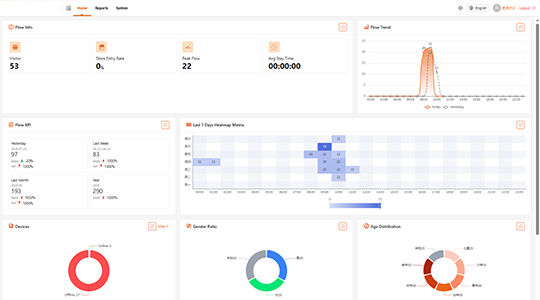
- People counting systems
- POS sales data
- Heatmap analytics
- Behavioral tracking models
This integration enables a full view of store performance.
When combined properly, it answers three critical questions:
- How many people enter?
- How many actually engage?
- How many convert into buyers?
This is the foundation of modern retail optimization.
Without it, decision-making remains guesswork.
Conclusion: From counting people to understanding customers
Measuring traffic in retail stores has evolved far beyond simple entry counters. The real value lies in real customer traffic measurement in retail stores accurately, where data reflects actual human behavior, not just movement.
With the help of people counting systems, retail foot traffic analytics, and AI-driven filtering models, retailers can finally separate noise from meaningful insight.
The result is clearer decisions, better store performance, and a more realistic understanding of customer behavior.
In modern retail, it is no longer about how many people walked in—it is about how many actually mattered.