
For decades, retailers have relied on a simple question to understand store performance:
“How many people entered the store today?”
However, modern retail competition has changed the meaning of traffic data. A high visitor number does not always represent strong business performance. Employees walking through the entrance, repeated visits from the same person, delivery personnel, and visitors without purchase intention can all influence traditional counting results.
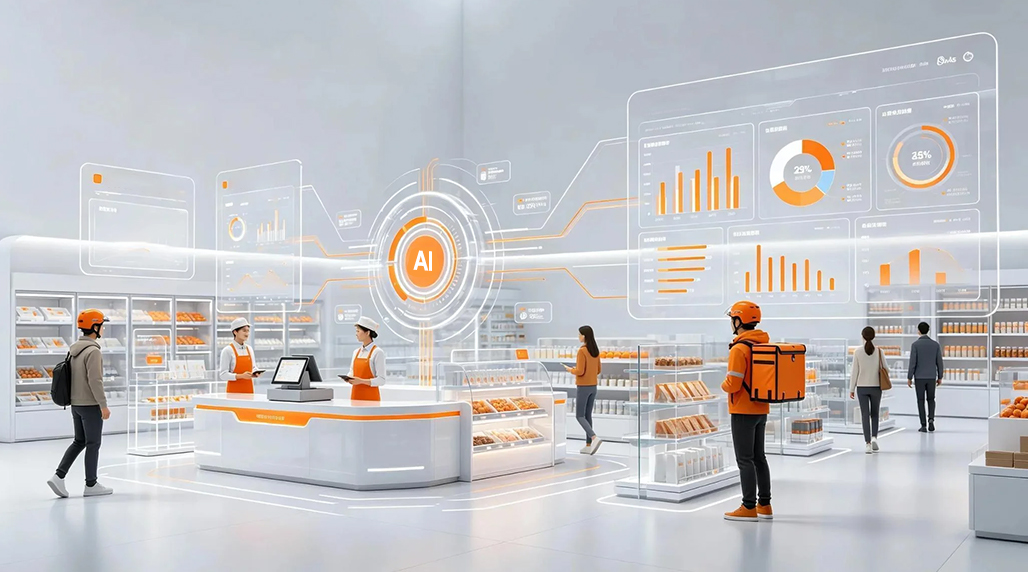
This is why Retail Analytics Systems are becoming a critical technology for modern retailers. Instead of only counting visitors, these systems analyze who enters, how they behave, how long they stay, and whether the traffic represents real business opportunities.
The evolution from basic counting to intelligent analysis is transforming Customer Footfall Measurement from a simple statistic into a strategic decision-making tool.
Why Are Traditional Footfall Counting Methods No Longer Enough?
Traditional people counters were designed to answer one question:
“How many people passed through this entrance?”
While this information is useful, it lacks business context.
For example, two stores may both receive 5,000 visitors per month. However:
- Store A generates 500 purchases.
- Store B generates 1,200 purchases.
The difference is not traffic volume. The difference is traffic quality.
Modern Retail Analytics Systems help retailers understand the value behind visitor numbers by identifying meaningful customer activity.
Advanced systems powered by AI technologies can analyze:
- Real customer visits
- Repeated visitors
- Employee movement
- Customer dwell time
- Visitor flow patterns
- Store zone engagement
This creates a more accurate picture of Retail Foot Traffic Analytics.
Frequently Asked Question 1:
What is the difference between people counting and retail analytics?
Traditional people counting focuses only on quantity.
Retail analytics combines counting data with behavioral insights. It helps retailers understand not only how many people entered but also how visitors interacted with the store.
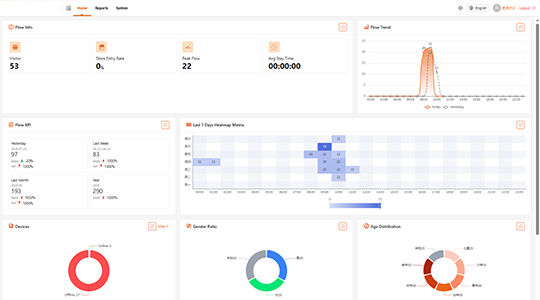
A modern AI People Counting System can provide deeper information, including customer flow trends, peak periods, conversion opportunities, and operational optimization suggestions.
The goal is no longer “counting visitors.”
The goal is understanding valuable visitors.
From Visitor Numbers to Customer Intelligence
The biggest change brought by Retail Analytics Systems is the transition from basic measurement to intelligent decision support.
Retailers previously depended heavily on sales reports. However, sales data only shows the final result. It does not explain why sales increased or decreased.
Foot traffic data provides the missing connection.
For example:
- Sales decreased by 15%.
- Did fewer customers enter?
- Did customers spend less time inside?
- Did store layout changes reduce engagement?
- Did marketing campaigns attract the wrong audience?
With advanced Store Visitor Analytics, retailers can answer these questions.
AI-based systems analyze multiple signals and transform raw visitor data into actionable insights.
Important measurements include:
1. Visitor Flow Analysis
Understanding where customers move inside a store helps optimize:
- Product placement
- Promotional areas
- Store layout
- Staff allocation
2. Dwell Time Analysis
A customer staying longer in a product area may indicate higher purchase interest.
Dwell time data allows retailers to identify:
- Popular product zones
- Weak display areas
- Customer engagement problems
3. Accurate Customer Identification
Modern systems can reduce inaccurate counting caused by:
- Employees
- Repeated entries
- Non-shopping visitors
This improves Effective Foot Traffic Analysis, allowing retailers to focus on customers who have real commercial value.
How Do Retail Analytics Systems Improve Store Decisions?
Retailers today face increasingly complex decisions:
- Where should a new store open?
- How many employees are needed during peak hours?
- Which marketing campaign attracts valuable customers?
- Which store performs better?
Without accurate traffic intelligence, these decisions are often based on assumptions.
Retail Analytics Systems provide measurable evidence.
Frequently Asked Question 2:
Can foot traffic data improve retail conversion rates?
Yes.
Conversion rate is usually calculated as:
Sales Transactions ÷ Store Visitors
However, inaccurate visitor data creates misleading results.
If a store counts employees, repeated visitors, or non-potential customers as visitors, the conversion rate will appear lower than reality.
By improving Customer Footfall Measurement, retailers can calculate more meaningful conversion rates and better evaluate store performance.
The Role of AI in Modern Footfall Measurement
Artificial intelligence has significantly improved the accuracy and usability of retail traffic analysis.
Traditional sensors often struggle with complex environments:
- Crowded entrances
- Different lighting conditions
- Multiple people entering together
- Changing customer behavior
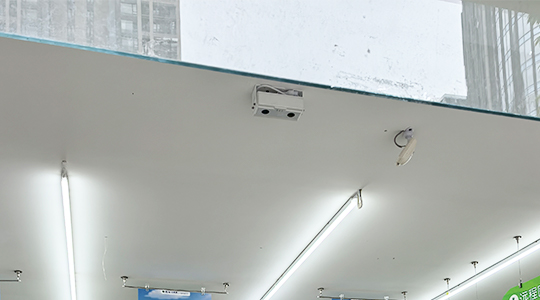
AI-powered systems use technologies such as computer vision, 3D sensing, and intelligent algorithms to improve recognition accuracy.
A modern AI People Counting System can support:
- Bidirectional counting
- Visitor filtering
- Staff exclusion
- Repeat visitor detection
- Customer behavior analysis
This allows retailers to move from simple visitor statistics toward complete customer intelligence.
The future of Retail Traffic Data is not about collecting more numbers.
It is about collecting more meaningful numbers.
How Does Accurate Footfall Data Support Marketing ROI?
Marketing investment is another area where better traffic measurement creates value.
Many retailers measure campaign success only through sales growth.
However, sales changes may be influenced by many factors.
With Retail Analytics Systems, companies can compare:
- Advertising campaigns
- Store visits
- Customer engagement
- Purchase results
For example:
A promotion generates 30% more visitors, but sales increase only 5%.
This may indicate that the campaign attracted low-value traffic.
Another campaign generates only 10% more visitors but doubles conversion rates.
The second campaign may create better business value.
Frequently Asked Question 3:
Why is effective foot traffic more important than total visitor numbers?
Because not every visitor contributes equally to revenue.
Effective foot traffic focuses on visitors who have genuine shopping potential. It removes noise from traditional counting methods and provides retailers with a clearer understanding of customer value.
This helps businesses optimize marketing, staffing, and store operations based on real customer behavior.
Future Trends: From Footfall Counting to Intelligent Retail Operations
The next generation of retail measurement will continue moving toward predictive analytics.
Future Retail Analytics Systems will not only answer:
“How many customers visited?”
They will help answer:
“What will customers likely do next?”
Through deeper integration with:
- CRM platforms
- POS systems
- Digital marketing platforms
- Smart store infrastructure
retailers will gain a complete understanding of customer journeys.
The combination of Customer Footfall Measurement, AI analysis, and business intelligence will become a foundation for data-driven retail management.
Conclusion: Retail Analytics Systems Create a New Standard for Customer Footfall Measurement
The value of retail traffic data is no longer determined by the number of visitors counted.
The real value comes from understanding visitor quality, behavior, and business impact.
Modern Retail Analytics Systems are redefining Customer Footfall Measurement by transforming simple counting into intelligent customer analysis.
For retailers, the future is not about knowing how many people entered the store.
It is about knowing:
Who they are, what they need, and how their behavior creates business value.
That is the real evolution of retail analytics.