
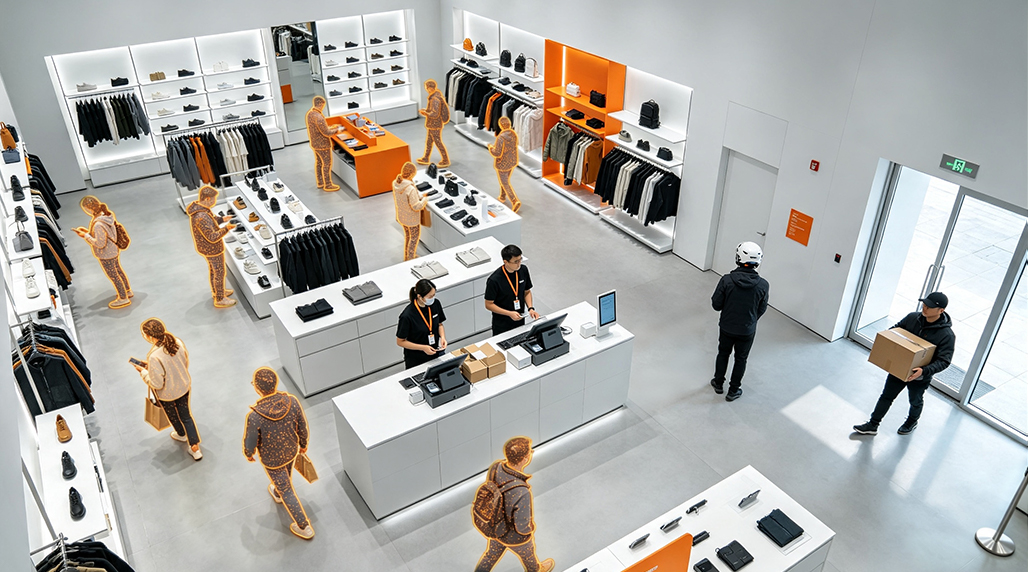
Retail success has always depended on understanding customers. However, many retailers still make important decisions based only on sales data, ignoring one critical question: How many real customers actually entered the store?
This is why Accurate People Counting has become increasingly important in modern retail management.
Traditional counting methods can tell retailers how many people passed through a door, but they often fail to distinguish employees, repeated visitors, delivery personnel, and actual shoppers. As a result, businesses may calculate incorrect conversion rates, misjudge marketing performance, or make poor staffing decisions.
With the development of smart retail technology, Accurate People Counting provides a more reliable way to understand customer behavior. By collecting precise visitor data and combining it with Retail Foot Traffic Analysis, retailers can move from simple traffic statistics to data-driven decision-making.
Why do retailers need accurate people counting?
A common question from retailers is:
“Why are sales data alone not enough to evaluate store performance?”
Sales figures only show the final transaction results. They do not explain how many potential customers visited, how many people left without purchasing, or whether marketing campaigns actually attracted valuable visitors.
For example, two stores may generate the same monthly revenue, but their situations could be completely different.
Store A receives 10,000 visitors and generates 500 orders.
Store B receives 3,000 visitors and generates 500 orders.
Without accurate traffic measurement, both stores appear equally successful. However, Store B may have stronger customer attraction and higher operational efficiency.
This is where Customer Traffic Measurement becomes valuable. Accurate visitor data helps retailers understand the relationship between traffic volume and purchasing behavior.
By analyzing real customer flow, businesses can answer important questions:
- Are promotions bringing valuable customers?
- Are store locations attracting enough visitors?
- Is employee scheduling matching customer demand?
- Why is conversion rate increasing or decreasing?
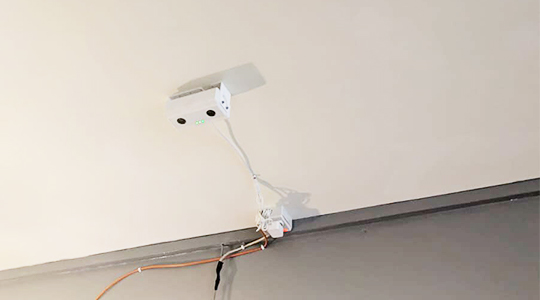
The problem with traditional people counting methods
Many traditional counting systems focus only on entrance and exit numbers. While this data seems useful, it often contains large amounts of inaccurate traffic information.
Common problems include:
1. Employees counted as customers
Retail employees frequently enter and exit stores multiple times every day. If these movements are included in traffic statistics, the store may appear busier than it actually is.
2. Repeated visitors create false traffic
Shopping malls, supermarkets, and large retail stores often have customers walking through multiple areas. Traditional systems may count the same person several times.
3. External traffic does not equal buying intention
A person entering a store does not always represent a potential buyer. Delivery workers, maintenance staff, and visitors without purchasing needs can influence the data.
Because of these issues, simple visitor counting cannot fully represent business performance.
Modern Accurate People Counting solutions use technologies such as 3D vision, AI recognition, and behavior analysis to improve data quality. These systems can identify different visitor types and provide more meaningful customer insights.
How accurate people counting improves retail decisions
1. More accurate conversion rate analysis
One of the biggest benefits of Accurate People Counting is improving conversion rate calculation.
Retail conversion rate is usually calculated as:
Number of purchases ÷ Number of visitors × 100%
If visitor numbers are inaccurate, the conversion rate becomes unreliable.
For example:
A store records 1,000 visitors and 100 purchases.
The calculated conversion rate is 10%.
However, if 300 visitors were employees or repeated entries, the real customer traffic was only 700 people.
The actual conversion rate would be much higher.
Through Effective Customer Traffic analysis, retailers can evaluate store performance based on real shoppers instead of simple footfall numbers.
2. Better staffing and store operation planning
Another common question is:
“Can people counting technology help reduce operating costs?”
The answer is yes.
Retail managers need to know when customers arrive, how long they stay, and which periods have the highest demand.
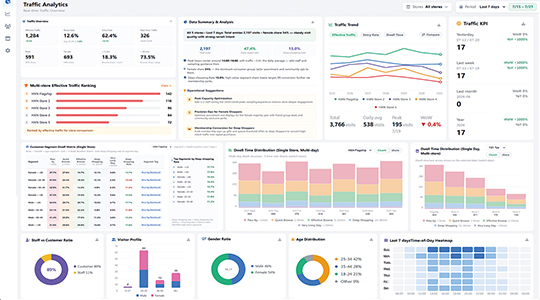
With Retail Analytics, businesses can analyze:
- Peak shopping hours
- Customer waiting periods
- Staff allocation efficiency
- Store occupancy changes
For example, if traffic data shows that customer volume increases significantly between 5 PM and 8 PM, managers can schedule more employees during this period.
This improves customer service while avoiding unnecessary labor costs during slower hours.
3. Understanding customer behavior beyond numbers
Modern retail competition is no longer only about attracting visitors. It is about understanding what visitors do inside the store.
Advanced Retail Foot Traffic Analysis can provide insights into:
- Customer staying time
- Popular store areas
- Visitor movement patterns
- Product display effectiveness
A retailer may discover that many customers enter a store but leave within one minute. This could indicate problems with product layout, pricing, or customer experience.
Traffic data becomes more valuable when combined with behavioral analysis.
Frequently asked questions about accurate people counting
Q1: Is people counting the same as customer counting?
No.
Traditional people counting measures the number of people passing through an area.
Customer counting focuses on identifying actual potential shoppers.
A professional Accurate People Counting system should help filter irrelevant traffic, including employees and repeated visitors, creating cleaner business data.
Q2: How accurate are modern retail counting systems?
Accuracy depends on technology, installation environment, and algorithm performance.
Modern AI-based systems using 3D sensing technology can achieve significantly higher accuracy compared with traditional infrared or manual counting methods, especially in complex environments with crowds and changing lighting conditions.
Q3: How can retailers use traffic data to increase revenue?
Traffic data itself does not create sales, but it helps retailers make better decisions.
Businesses can use customer flow information to:
- Improve store layout
- Optimize marketing campaigns
- Increase conversion rates
- Adjust staffing strategies
- Compare store performance
Reliable Customer Traffic Measurement turns visitor information into actionable business insights.
The future of retail decision-making depends on better traffic data
Retailers are moving from simple counting toward intelligent customer understanding.
In the past, businesses asked:
“How many people entered my store?”
Today, they need to ask:
“How many valuable customers visited, what did they do, and how can we improve their experience?”
This shift makes Accurate People Counting an important foundation for modern retail analytics.
By combining precise traffic measurement, customer behavior insights, and operational analysis, retailers can make decisions based on facts instead of assumptions.
The future of retail will not be driven by more traffic alone. It will be driven by understanding the value behind every visitor.
Conclusion
Accurate visitor data is becoming a key competitive advantage for retail businesses. Traditional footfall numbers can provide basic information, but they cannot fully explain customer value.
Through Accurate People Counting, retailers can obtain reliable traffic insights, improve Store Conversion Rate, optimize operations, and better understand customer behavior.
For businesses seeking sustainable growth, accurate traffic measurement is no longer just a counting tool. It is a strategic decision-making system that connects customer movement with business performance.