
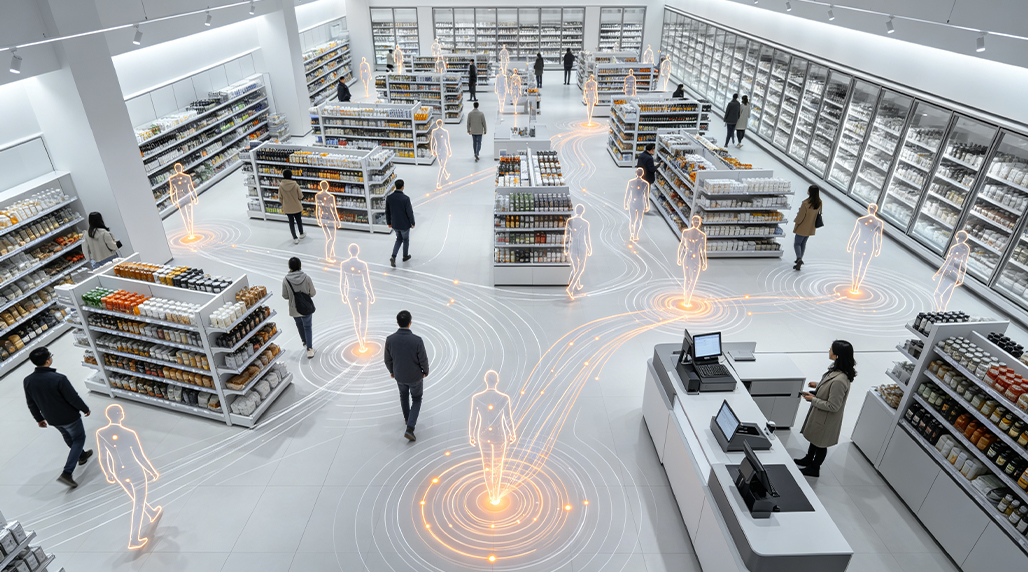
For decades, retailers have relied on one simple question to evaluate store performance:
“How many people entered the store today?”
This question created an entire industry around traffic measurement. However, as retail competition becomes more complex, counting visitors alone is no longer enough.
A store may receive thousands of visitors every month but generate disappointing sales results. Another store with fewer visitors may achieve stronger revenue because those visitors have clearer purchasing intentions.
The difference is not traffic volume. The difference is understanding Customer Intent.
Modern retailers need to move beyond basic counting and understand who visitors are, why they enter, how they behave, and whether they represent real business opportunities.
This shift is changing the role of Retail Analytics from simple measurement into a decision-making system.
Why is traffic volume no longer enough for retail decisions?
Traditional footfall statistics provide a basic answer: the number of people entering or leaving a store.
However, this data has a major limitation. It treats every visitor as equal.
A store entrance may record:
- Employees entering during working hours
- Delivery personnel visiting the store
- Repeat visitors passing through multiple times
- Customers who only browse without purchase intention
- Genuine shoppers looking for products
From a counting perspective, all of these people are “traffic”.
From a business perspective, they have completely different values.
This is why many retailers experience a common problem:
High visitor numbers do not always create high revenue.
A shopping mall, for example, may have strong daily traffic, but individual stores inside the mall can have very different conversion results. Without understanding Customer Intent, managers cannot identify whether low sales come from insufficient traffic or poor-quality traffic.
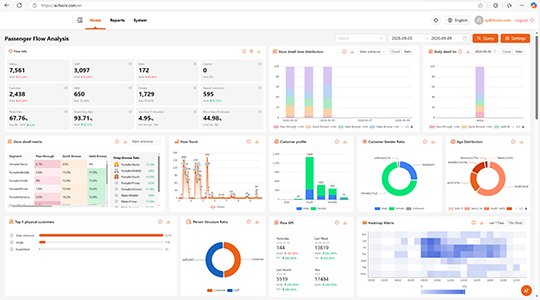
This is where advanced Foot Traffic Analysis becomes important. Instead of only answering “how many people came”, retailers need answers to:
- How many visitors were potential customers?
- Which time periods attracted high-value visitors?
- How long did customers stay?
- Which areas attracted the most attention?
The value of traffic data depends on the quality of insights behind the numbers.
How can retailers identify real customer intent?
One of the biggest challenges in physical retail is understanding offline customer behavior.
Online businesses have access to detailed user signals:
- Search history
- Click behavior
- Page visits
- Purchase journey
Physical stores traditionally had far fewer insights.
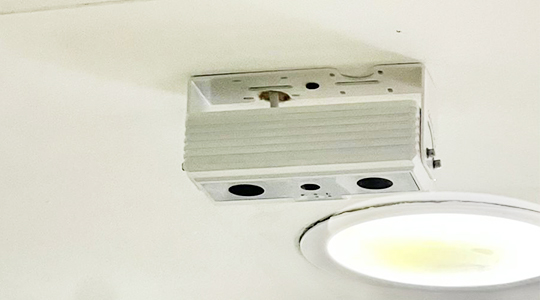
However, advances in AI People Counting and computer vision technologies are changing this situation.
Modern AI-based systems can analyze visitor patterns while protecting privacy. Instead of collecting personal information, these systems focus on anonymous behavioral data, including:
- Entry and exit movement
- Visit duration
- Customer flow direction
- Repeat visits
- Staff filtering
- Area occupancy
These capabilities allow retailers to better understand Customer Behavior Insights.
For example:
A clothing store notices that visitor numbers increase by 30% after 6 PM. Traditional data may suggest extending staff schedules.
But deeper analysis may reveal that most evening visitors stay less than one minute and rarely enter product areas. The problem is not staffing. The problem is attracting low-intent visitors.
Another store may have fewer visitors but higher average dwell time and stronger product engagement. These visitors represent more valuable opportunities.
The difference can only be discovered by analyzing intent, not simply counting people.
What is the difference between traffic quantity and traffic quality?
This is one of the most common questions from retailers.
Traffic quantity answers:
“How many people came?”
Traffic quality answers:
“How many visitors had real business value?”
A simple example:
Store A receives:
- 10,000 monthly visitors
- 300 purchases
- Conversion rate: 3%
Store B receives:
- 5,000 monthly visitors
- 400 purchases
- Conversion rate: 8%
Although Store A has double the traffic, Store B performs better because it attracts more valuable customers.
This is why many retailers are shifting from traditional traffic measurement toward effective foot traffic analysis.
Effective traffic focuses on visitors who are more likely to create commercial value. It removes noise from raw numbers and provides a clearer understanding of store performance.
For retail decision-makers, this information helps answer more important questions:
- Should marketing investment increase?
- Is store location delivering valuable visitors?
- Are promotions attracting the right customers?
- Should staffing schedules change?
Better answers lead to better decisions.
How does customer intent improve retail conversion rates?
Improving sales is not always about attracting more people.
Sometimes the solution is understanding existing visitors better.
Conversion Rate Optimization depends heavily on knowing customer behavior before purchase decisions happen.
When retailers understand intent signals, they can improve:
Store layout planning
If analytics show customers frequently stop in specific areas, retailers can optimize product placement and promotional displays.
Staff allocation
Stores can schedule employees based on real customer demand instead of fixed assumptions.
Marketing effectiveness
Retailers can evaluate whether campaigns bring valuable customers or only increase visitor numbers.
Store comparison
Multi-location retailers can compare stores using meaningful indicators instead of only total traffic.
A location with lower traffic but higher customer quality may deserve more investment than a busy store with poor conversion.
This is the practical value of combining Customer Intent analysis with modern retail technology.
Can AI help retailers understand customer intent without violating privacy?
Privacy is becoming an important concern for businesses adopting new analytics technology.
Many retailers worry that advanced customer analysis requires collecting personal data.
In reality, modern solutions increasingly focus on anonymous analysis.
Privacy-friendly AI systems can analyze:
- Movement patterns
- Visitor frequency
- Dwell time
- Traffic distribution
- Store utilization
without identifying individual customers.
Technologies such as 3D vision, edge computing, and AI algorithms allow data processing to happen efficiently while reducing unnecessary personal information collection.
This approach creates a balance between business intelligence and customer privacy.
For retailers, the goal is not to identify individuals.
The goal is to understand customer behavior patterns.
The future of retail measurement: from counting visitors to understanding value
Retail has entered a new stage of data-driven decision-making.
The question is no longer:
“How many people visited my store?”
The more important questions are:
“Who were these visitors?”
“Did they show purchasing interest?”
“Which traffic created business value?”
Traditional visitor counting still has value, but it represents only the first layer of retail intelligence.
The future belongs to businesses that combine Customer Intent, Retail Analytics, and AI People Counting technologies to understand the complete customer journey.
Retail success will not come from attracting the largest number of visitors.
It will come from attracting, understanding, and converting the right visitors.
When retailers stop measuring traffic volume alone and start analyzing customer intent, they gain a clearer path toward smarter operations, better investment decisions, and sustainable growth.