
Retailers have never had more data than they do today. Sales reports update in real time. Inventory moves automatically. Marketing campaigns generate detailed attribution reports.
Yet many retailers still rely on an outdated metric when evaluating store performance: footfall counting.
At first glance, counting everyone who walks through the entrance seems logical. More visitors should mean more sales, right?
Unfortunately, modern retail is far more complicated than that.
Traditional footfall counting systems often treat every person equally—employees arriving for work, delivery drivers, maintenance staff, repeat visitors, and actual shoppers all become identical data points. The result is a dataset that looks complete but tells an incomplete story.
As retailers compete on tighter margins and smarter operations, businesses are discovering that measuring customer quality matters far more than simply measuring customer quantity.
The Biggest Limitation of Traditional Footfall Counting
Conventional footfall counting technology was designed for one purpose:
Count every person entering or leaving a location.
Years ago, that was enough.
Today’s retailers, however, need answers to questions that basic counters were never built to solve.
For example:
- How many actual shoppers entered today?
- How many visitors were employees?
- How many customers returned multiple times?
- Which visitors spent more than five minutes inside?
- Which marketing campaign attracted genuine buyers instead of casual browsers?
Traditional systems cannot distinguish between these different visitor types.
Imagine a clothing store with:
- 420 shoppers
- 65 employees
- 30 courier deliveries
- 28 supplier visits
- 42 repeat customer entries
A legacy people counting system might simply report:
Total Visitors: 585
Although technically correct, this number provides little business value because it mixes customer behavior with operational activity.
This makes retail traffic analytics less reliable and weakens every decision built upon those numbers.
Why Poor Customer Traffic Data Hurts Retail Decisions
Many retailers assume inaccurate traffic data only affects reporting.
In reality, it influences nearly every operational decision.
Conversion Rate Becomes Misleading
Store conversion is calculated by dividing purchases by visitor numbers.
If the visitor count includes employees and non-buyers, conversion rates appear artificially low.
Managers may incorrectly conclude that sales teams are underperforming when the problem actually lies in inaccurate traffic measurement.
Staffing Decisions Become Less Efficient
Scheduling often depends on historical traffic.
Inflated visitor counts can result in unnecessary staffing during quiet periods while leaving peak shopping hours understaffed.
Modern customer counting should reflect actual purchasing demand—not simply movement through the entrance.
Marketing ROI Gets Distorted
A campaign that increases total entries isn’t always successful.
If most additional visitors are returning staff, delivery personnel, or people passing through shared entrances, the campaign appears effective while generating little real revenue.
This is why smarter retail footfall analysis has become increasingly important.
AI Is Changing the Meaning of Footfall Counting
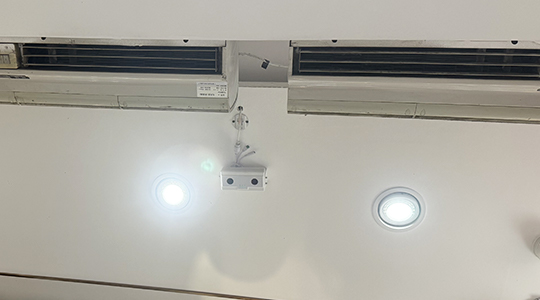
Artificial intelligence is transforming footfall counting from a simple counting exercise into customer intelligence.
Instead of recording anonymous movement, modern AI systems analyze behavior patterns while maintaining privacy through edge processing and anonymous identifiers.
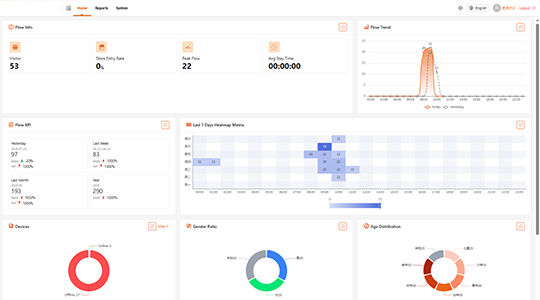
Today’s AI people counter technologies can identify patterns such as:
- Employee exclusion
- Repeat visitor detection
- Customer re-identification across entrances
- Adult and child classification
- Dwell time analysis
- Zone occupancy
- Queue monitoring
- Peak shopping periods
Rather than asking,
“How many people entered?”
Retailers can now ask,
“How many real shopping opportunities did we create today?”
That difference fundamentally changes decision-making.
From Raw Numbers to Actionable Retail Intelligence
The most valuable retailers no longer optimize for traffic volume alone.
They optimize for traffic quality.
Consider two stores.
Store A
- 1,000 recorded visitors
- 80 sales
- 8% conversion
Store B
- 760 verified customers
- 92 sales
- 12.1% conversion
Traditional visitor counting would suggest Store A performs better because it attracts more people.
AI-powered analysis reveals the opposite.
Store B generates more sales from fewer genuine shoppers, making it significantly more efficient.
This shift from raw counts to verified customer traffic enables retailers to improve:
- Store layouts
- Product placement
- Staff allocation
- Marketing investment
- Promotion timing
- Customer experience
In other words, better data produces better business decisions.
Frequently Asked Questions
Is traditional footfall counting still useful?
Yes.
Basic footfall counting remains useful for measuring overall building occupancy, safety compliance, and general traffic trends.
However, it is no longer sufficient for detailed retail performance analysis because it cannot separate genuine shoppers from other visitors.
Why do conversion rates differ between stores with similar traffic?
The quality of customer traffic often varies dramatically.
One store may receive many repeat visits, employees, or service personnel, while another attracts a higher percentage of purchasing customers.
Without filtering invalid traffic, comparing conversion rates becomes unreliable.
What makes AI-based people counting systems more accurate?
Modern AI systems combine computer vision, edge AI, and behavioral analytics to recognize different visitor patterns.
Instead of simply counting entries, they identify meaningful customer activity while filtering many non-shopping movements.
This creates cleaner datasets for business analysis and improves the accuracy of store conversion rate calculations.
Should retailers replace traditional counters immediately?
Not necessarily.
Many retailers begin by upgrading locations where accurate customer insights directly affect profitability, such as flagship stores, shopping malls, supermarkets, and chain locations.
The goal isn’t replacing hardware for its own sake—it’s improving decision quality through more meaningful traffic data.
Conclusion
For years, footfall counting helped retailers understand whether people were entering their stores.
Today, that question is no longer enough.
Retail success depends on understanding who those visitors are, how they behave, and whether they represent genuine buying opportunities.
Modern retail traffic analytics shifts the focus from counting every person to identifying meaningful customer interactions. As AI capabilities continue to evolve, retailers that rely solely on traditional counting methods risk making strategic decisions based on incomplete or misleading information.
The future of footfall counting is not about collecting more numbers—it is about generating smarter insights that improve conversion, operational efficiency, and long-term profitability.