
For many retailers, revenue reports tell only the final result: sales increased or declined. However, sales numbers alone cannot explain why performance changes.
A store may have strong sales because it attracts high-quality customers. Another store may receive thousands of visitors but generate limited revenue because most visitors never purchase.
The difference is not simply the number of people entering a store. The key is understanding customer opportunities through accurate Traffic Data.
Modern retailers are moving from traditional visitor counting toward data-driven decision-making. By combining Traffic Data, sales information, and customer behavior analysis, businesses can identify hidden revenue opportunities, optimize operations, and improve store profitability.
Why Traditional Store Data Cannot Explain Revenue Problems
A common mistake in retail management is focusing only on sales results.
When revenue decreases, many managers immediately ask:
- Are products competitive enough?
- Are prices attractive?
- Is marketing effective?
However, another important question is often ignored:
Did the store actually receive enough valuable customers?
Without reliable Traffic Data, retailers cannot separate different problems:
- Low revenue caused by insufficient customer visits
- Low conversion caused by poor sales processes
- Low purchase intent caused by wrong product positioning
- Poor staffing allocation during peak periods
For example, two stores may generate the same revenue decline, but their solutions could be completely different.
Store A may have fewer visitors because surrounding customer traffic decreased.
Store B may have normal visitor numbers but poor conversion because employees cannot serve customers effectively.
Only accurate Retail Analytics can reveal the real reason behind performance changes.
FAQ 1: How Can Traffic Data Improve Store Revenue?
The biggest value of Traffic Data is that it connects customer visits with business outcomes.
Traditional retail measurement usually follows this logic:
Visitors → Sales
But modern retail requires a deeper understanding:
Visitors → Customer behavior → Purchase intention → Conversion → Revenue
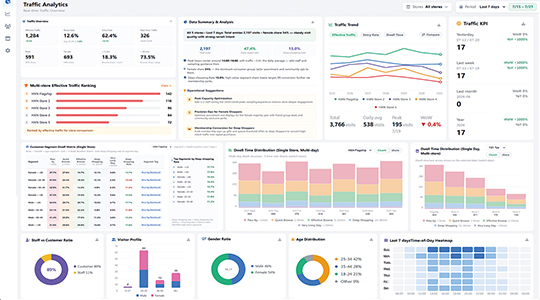
Through Foot Traffic Analytics, retailers can understand:
- How many customers enter the store
- Which hours generate the highest customer demand
- How long customers stay
- Which areas attract attention
- Which stores convert traffic better
For example, if a clothing retailer discovers that customer traffic peaks between 18:00 and 20:00 but sales staff numbers remain unchanged, increasing employee coverage during this period may directly improve conversion.
The goal is not simply attracting more visitors.
The goal is converting more valuable visits into revenue.
From Counting Visitors to Understanding Customers
Traditional people counting systems answer one basic question:
“How many people entered?”
However, revenue improvement requires more meaningful answers:
- Who are potential buyers?
- Which visits represent real customer opportunities?
- Which traffic sources create sales?
- Why do some visitors leave without purchasing?
This is why retailers increasingly focus on Customer Behavior Insights.
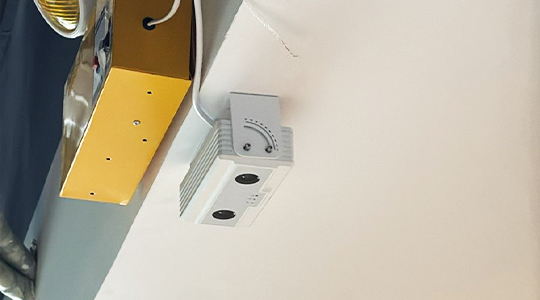
Modern People Counting System technologies can provide more than entry and exit numbers. Advanced systems can analyze customer flow patterns, dwell time, repeat visits, and store zone activity while protecting customer privacy.
For multi-store retailers, this information becomes especially valuable.
Headquarters can compare:
- Which locations attract more effective traffic
- Which stores have stronger conversion ability
- Which stores need operational improvement
Data replaces assumptions.
FAQ 2: Can Better Traffic Data Increase Store Conversion Rate?
Yes. One of the most important applications of Traffic Data is improving Store Conversion Rate.
Conversion rate is not only affected by product quality.
It is influenced by:
- Staff availability
- Customer waiting time
- Store layout
- Product display
- Customer engagement
Without accurate traffic measurement, retailers often optimize the wrong factors.
For example:
A store manager may believe sales are low because customer interest is weak.
But traffic analysis may reveal:
- Many customers enter during lunch hours
- Staff coverage is insufficient
- Customers leave before receiving assistance
The problem is not customer demand.
The problem is operational matching.
By connecting Customer Traffic Data with sales performance, retailers can identify improvement opportunities and increase revenue without increasing advertising expenses.
FAQ 3: How Does Traffic Data Help Retailers Optimize Store Operations?
Operational efficiency is another major benefit of Retail Traffic Data.
Retail stores often face a difficult balance:
Too many employees during quiet periods increase costs.
Too few employees during busy periods reduce customer experience.
Accurate Store Traffic Analytics helps retailers create smarter staffing strategies.
Examples:
Peak-hour staffing optimization
Traffic data identifies customer peaks, allowing managers to schedule employees based on actual demand.
Store layout improvement
Customer movement patterns show which areas receive attention and which zones are ignored.
Marketing evaluation
Retailers can compare campaigns with actual customer visits instead of relying only on sales results.
A promotion that increases visitors but does not improve purchases may need adjustment.
A smaller campaign that attracts fewer but higher-value customers may deliver better ROI.
The Future of Retail Revenue Growth Is Data Quality
Many companies already collect large amounts of retail data.
The challenge is not data availability.
The challenge is data accuracy and usability.
Poor-quality traffic information creates incorrect decisions.
If employee movement, delivery personnel, repeated entries, or inaccurate counting are included, retailers may misunderstand real customer demand.
This is why effective Traffic Data must focus on identifying valuable customer traffic rather than simply counting every movement.
The future of retail analytics is shifting from:
“How many people came?”
to:
“How many real customers created business opportunities?”
This transformation allows retailers to evaluate stores more accurately, improve customer experience, and make smarter investment decisions.
Conclusion: Better Traffic Data Creates Better Revenue Decisions
Revenue growth is not always achieved by attracting more customers.
Sometimes the biggest opportunity comes from understanding existing customer traffic better.
Accurate Traffic Data helps retailers answer critical business questions:
- Are enough customers entering the store?
- Are visitors converting into buyers?
- Are employees aligned with customer demand?
- Which stores have growth potential?
- Which operational changes create measurable results?
When combined with Retail Analytics, Foot Traffic Analytics, and Customer Behavior Insights, traffic information becomes more than a counting tool.
It becomes a strategic foundation for improving store revenue performance.
The retailers that succeed in the future will not simply count visitors.
They will understand customers.