
Introduction: The Problem Hidden Behind Large Traffic Numbers
For many retailers, measuring store performance starts with a simple question:
“How many people entered my store today?”
This question has existed for decades. A higher visitor number often appears to represent stronger customer demand, better marketing performance, and greater sales potential.
However, in modern retail environments, relying only on Raw Footfall Data can create a dangerous illusion.
A store may report thousands of visitors every day but still struggle with low conversion rates. Another store with fewer visitors may generate higher revenue because its visitors have stronger purchase intent.
The problem is not the lack of data. The problem is misunderstanding what the data actually represents.
Traditional counting systems answer one basic question: how many people passed through an entrance. But retail decisions require deeper insights:
- Who are the real customers?
- Which visitors create business value?
- How do customers interact with the store?
- Why does traffic increase but revenue remain unchanged?
This is why modern retailers are moving from simple counting toward Retail Foot Traffic Analytics and data-driven customer understanding.
Why Can Raw Footfall Data Mislead Retail Decisions?
The biggest limitation of Raw Footfall Data is that it measures movement, not business value.
A traditional people counting system may record every entrance event, but not every visitor represents a sales opportunity.
For example, daily traffic numbers may include:
- Employees entering and leaving the store
- Delivery or service personnel
- Repeated entries from the same visitor
- Visitors who do not contribute to actual customer demand
When these factors are included, the final number can look impressive while the real customer opportunity is much smaller.
This creates several problems.
A retail manager may believe a store location has strong customer attraction because traffic numbers are high. However, after analyzing Effective Foot Traffic, the business may discover that the actual customer base is significantly different.
The difference between “people entering” and “potential customers entering” directly affects:
- Store performance evaluation
- Marketing ROI analysis
- Employee scheduling
- Location expansion decisions
- Sales conversion measurement
A large traffic number is not always a good result. The quality of traffic matters more than the size of traffic.
FAQ 1: Why Is Footfall Data Not Enough to Measure Store Performance?
Many retailers ask:
“If my store has more visitors, why are my sales not increasing?”
The answer is that visitor quantity does not equal customer value.
Retail performance depends on the relationship between traffic quality and purchasing behavior.
A simple example:
Store A receives:
- 5,000 visitors per week
- 2% conversion rate
Store B receives:
- 3,000 visitors per week
- 8% conversion rate
Although Store A has higher traffic volume, Store B creates more customers.
Without Customer Behavior Analytics, retailers cannot understand the reasons behind these differences.
Modern retail analysis requires additional information, including:
- Visitor staying time
- Customer movement patterns
- Popular areas inside the store
- Peak shopping periods
- Relationship between visitors and transactions
This is the shift from counting visitors to understanding customers.
The Difference Between Traffic Volume and Traffic Value
A common mistake in retail management is treating all visitors equally.
However, different traffic sources create different business outcomes.
Consider two situations:
A shopping center store receives heavy traffic because of its location near an entrance. Many people enter briefly but leave quickly.
Another store receives fewer visitors, but customers spend more time browsing products and interacting with displays.
Which store performs better?
The answer cannot be found through simple counting.
This is where Footfall Analytics becomes valuable.
Instead of focusing only on visitor numbers, advanced analysis looks at:
- Customer engagement
- Dwell time
- Store area interaction
- Returning visitor patterns
- Conversion opportunities
The purpose of analytics is not to collect more numbers. It is to identify which numbers can support better decisions.
FAQ 2: How Does Accurate Customer Traffic Data Improve Retail Strategy?
Retailers often ask:
“How can customer traffic data actually improve revenue?”
The answer is by connecting physical store behavior with operational decisions.
Accurate traffic insights help retailers answer practical questions.
1. How should stores schedule employees?
Many stores still schedule employees based on experience.
However, customer demand changes throughout the day.
By analyzing traffic patterns, retailers can identify:
- Busy hours requiring more staff
- Low-demand periods suitable for operational tasks
- Seasonal traffic changes
This improves both customer experience and labor efficiency.
2. Which store areas need improvement?
A store may have attractive products, but customers may not reach them.
Through Retail Foot Traffic Analytics, businesses can understand:
- Which areas receive attention
- Which displays attract customers
- Which sections have low engagement
This information supports better store layout decisions.
3. Which marketing campaigns actually work?
Many retailers invest heavily in advertising and promotions.
But increased traffic does not always mean successful marketing.
By comparing campaigns with Effective Foot Traffic changes, businesses can identify whether promotions bring valuable customers or only temporary visitor increases.
FAQ 3: How Can Retailers Reduce the Risk of Wrong Decisions From Traffic Data?
The solution is not collecting more data. It is improving data quality.
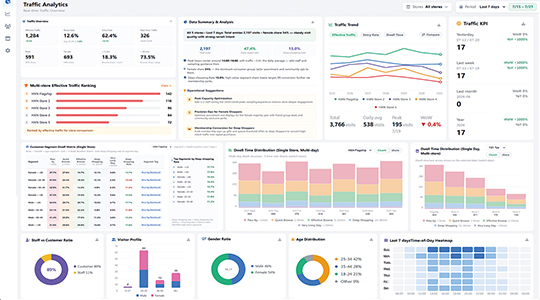
A reliable retail data system should combine multiple dimensions:
1. Accurate Counting Technology
Modern AI-based people counting solutions can improve measurement accuracy by using computer vision technology instead of simple movement detection.
These systems can analyze:
- Entry and exit direction
- Visitor identification
- Employee exclusion
- Repeat visitor filtering
The goal is creating cleaner customer traffic information.
2. Combine Traffic Data With Business Data
Traffic numbers become meaningful when connected with:
- Sales records
- Transaction volume
- Store hours
- Marketing activities
A visitor number alone is only a measurement.
A visitor number connected with revenue becomes business intelligence.
3. Focus on Effective Foot Traffic
The future of retail measurement is moving from “how many people came” to “how many valuable customers arrived.”
Effective Foot Traffic provides a clearer understanding of real customer opportunities.
It helps retailers avoid decisions based on inflated visitor numbers and build strategies based on actual customer behavior.
From Counting Visitors to Building Retail Intelligence
The retail industry is entering a new stage.
In the past, businesses competed by attracting more visitors.
Today, successful retailers compete by understanding visitors better.
Raw Footfall Data still has value, but it should not be treated as the final answer.
Numbers without context can easily lead to incorrect conclusions.
Modern retailers need Retail Data Intelligence systems that transform simple traffic measurement into actionable insights.
The key question is no longer:
“How many people entered my store?”
The more important question is:
“Among those visitors, how many represent real business opportunities?”
When retailers understand the difference, customer traffic becomes more than a statistic. It becomes a foundation for smarter decisions, better customer experiences, and sustainable growth.