
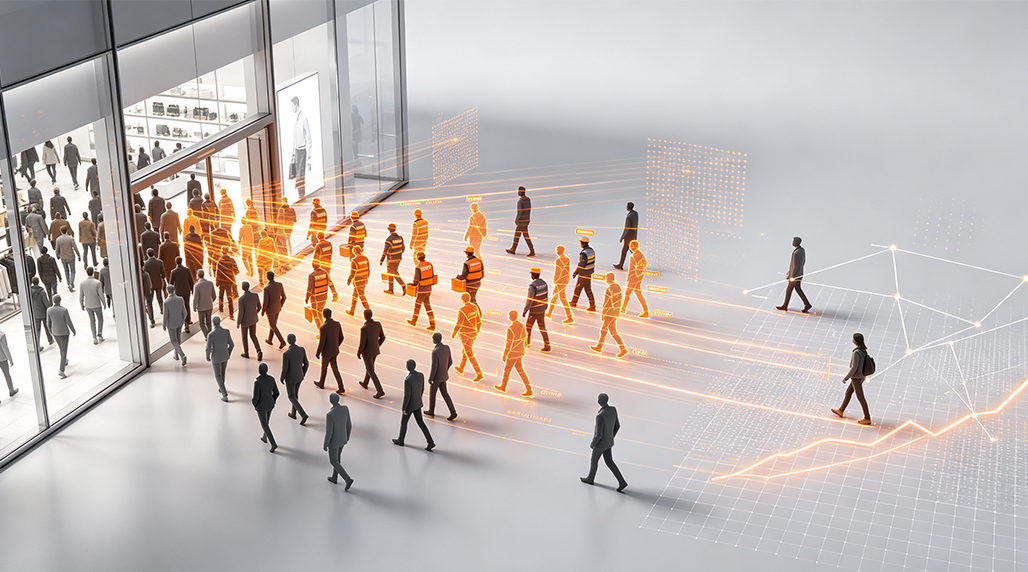
For many retailers, measuring store performance begins with one simple number: how many people entered the store today.
This number appears easy to understand. More visitors should mean more sales opportunities. However, modern retail has discovered a more complex reality: Retail Success does not depend only on how many people walk through the entrance. It depends on understanding who those visitors are, what they do inside the store, and whether they represent real business opportunities.
A busy store does not always mean a successful store.
A location may record thousands of daily visitors, but those numbers can include employees, delivery workers, repeated entries, or visitors with no purchase intention. When all traffic is treated equally, retailers may make decisions based on inaccurate assumptions.
The future of retail is moving from simple visitor counting toward deeper Retail Analytics, where businesses analyze visitor quality, customer behavior, and conversion potential.
The Problem With Measuring Only Store Visitors
Traditional people counting systems answer one basic question:
“How many people entered my store?”
This information is useful, but it is incomplete.
A visitor number alone cannot explain:
- Why sales increased or decreased
- Whether marketing campaigns attracted valuable customers
- Whether traffic growth came from real shoppers
- Whether store conversion rates are accurate
For example, a clothing store may report 2,000 visitors in one week. However, that number may include employees entering multiple times, delivery personnel, and customers who only stepped inside briefly without shopping.
The store appears busy, but the actual customer opportunity may be much smaller.
This is why modern Store Traffic Analytics focuses not only on traffic volume but also on traffic quality.
The key question has changed from:
“How many people entered?”
to:
“How many valuable customer opportunities entered?”
That shift is becoming one of the most important changes influencing Retail Success.
FAQ 1: Why Is High Foot Traffic Not Always Equal to Higher Sales?
Many retailers assume more visitors automatically create better business results.
However, visitor quantity and customer value are not the same thing.
A store with 5,000 visitors per month may perform worse than a store with 3,000 visitors if the second store attracts more relevant customers.
The reason is simple: not every visitor has the same commercial value.
Traditional traffic measurement often combines:
- Genuine shoppers
- Employees
- Service workers
- Delivery staff
- Repeat visitors
- People passing through
When these groups are mixed together, important retail indicators become inaccurate.
For example, conversion rate is calculated as:
Conversion Rate = Purchases ÷ Visitors
If visitor data contains a large amount of non-customer traffic, the conversion rate appears lower than the actual performance.
A store may believe its sales process is weak, when the real problem is inaccurate visitor measurement.
This is why Effective Foot Traffic has become increasingly important. It focuses on identifying meaningful customer visits rather than simply counting movement.
Understanding Who Enters Creates Better Retail Decisions
Modern retailers need more than numbers. They need context.
Understanding visitors allows businesses to answer practical questions:
- Are marketing campaigns attracting target customers?
- Are store locations generating valuable traffic?
- Are employees influencing traffic reports?
- Are visitors spending enough time inside the store?
This requires advanced Customer Behavior Analysis.
Instead of only measuring entrances and exits, retailers can analyze patterns such as:
- Visit duration
- Repeat visits
- Entry and exit behavior
- Customer flow direction
- Engagement areas
- Traffic changes by time period
These insights help retailers understand the difference between activity and opportunity.
A store with moderate traffic but strong customer engagement may have greater growth potential than a store with large traffic volume but weak customer interest.
This is where data becomes more meaningful.
The goal of Retail Success is not to attract the maximum number of people. It is to attract and understand the right people.
FAQ 2: How Can Retailers Identify Real Customers From General Traffic?
One of the biggest challenges in physical retail is separating customers from non-customer movement.
A traditional sensor can detect that someone crossed an entrance point, but it does not always understand the purpose behind that movement.
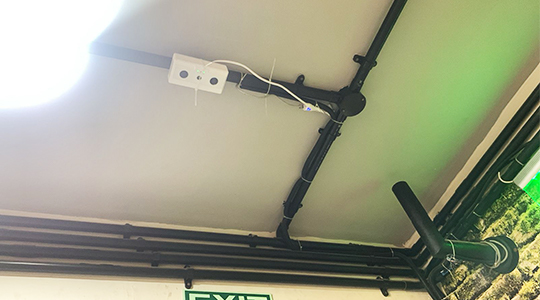
Modern AI-based systems improve this process by analyzing anonymous behavioral patterns.
An AI People Counting System can help retailers identify:
- Repeated entries from the same visitor
- Employee movement patterns
- Dwell time inside the store
- Customer flow characteristics
- Differences between short visits and meaningful visits
The purpose is not to collect personal information. Instead, it is to create more accurate business insights from anonymous traffic data.
For example:
A store notices that visitor numbers increased by 30%.
Traditional analysis may conclude:
“Customer demand is growing.”
However, deeper analysis may reveal:
- Most visitors stayed less than one minute
- Traffic increased during delivery periods
- Product engagement did not improve
The result changes the business conclusion.
The store did not gain more customers. It gained more activity.
This distinction is essential for improving Retail Success.
FAQ 3: How Does AI Change Modern Retail Analytics?
Artificial intelligence is changing how retailers understand physical stores.
Previously, retail data focused mainly on counting.
Today, the focus is shifting toward interpretation.
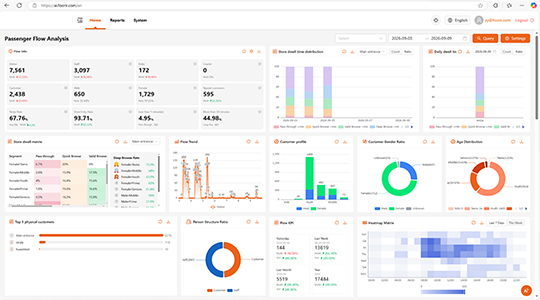
Modern Retail Analytics combines multiple data layers:
1. Traffic Measurement
The system collects entry and exit information to understand visitor volume.
2. Behavior Understanding
Algorithms analyze movement patterns, dwell time, and customer engagement.
3. Quality Assessment
The system separates meaningful customer traffic from invalid traffic sources.
4. Business Connection
The insights are connected with conversion, staffing, marketing, and store operations.
This creates a more complete picture of store performance.
Retailers can move from:
“We have many visitors.”
to:
“We understand which visitors create business value.”
This is a fundamental improvement in retail decision-making.
Why Effective Foot Traffic Is Becoming a Key Retail Metric
The retail industry is entering a new stage.
For many years, companies competed for more visitors.
Today, they compete for better understanding.
Effective Foot Traffic provides a clearer view of customer opportunities because it focuses on visitors who are more relevant to business outcomes.
This helps retailers improve:
Marketing Evaluation
Businesses can measure whether campaigns attract real shopping customers instead of only increasing visitor numbers.
Store Operations
Staff scheduling can be based on actual customer demand instead of inaccurate traffic peaks.
Store Expansion Decisions
Location evaluation becomes more reliable when retailers understand traffic quality.
Conversion Analysis
Sales performance can be evaluated using more accurate customer numbers.
These improvements make Retail Success more measurable and predictable.
The Future of Retail: From Counting People to Understanding Customers
The biggest change in retail analytics is not technology alone.
It is a change in thinking.
The old question was:
“How many people entered my store?”
The new question is:
“Who entered, what did they do, and what value did they create?”
Retailers that understand this difference will make smarter decisions.
Simple counting provides information.
Advanced Customer Behavior Analysis provides understanding.
As physical stores become more data-driven, businesses will increasingly rely on AI-powered insights, accurate traffic measurement, and deeper visitor understanding.
The competitive advantage will not belong to stores with the highest visitor numbers.
It will belong to stores that understand their customers best.
That is the foundation of modern Retail Success.